
-
Recent Posts
- Talk on Thigmotaxis – the Human ‘Wall-Hugging’ trait: Tuesday, March 10, 11 am ET, 15:00 CET
- Now On YouTube: Why Your Eyes Ignore Modern Buildings !
- How do People Respond to Nature in the Suburbs? Take part in this Biometric Study + Help us find out!
- This Eye-Tracking pilot-study is now out for analysis;
- Aiming for a Happy-2025 Holiday? Pick up the HAPI-Course Bundled!
Blogroll
-
Join 2,703 other subscribers
Author Archives: Genetics of Design
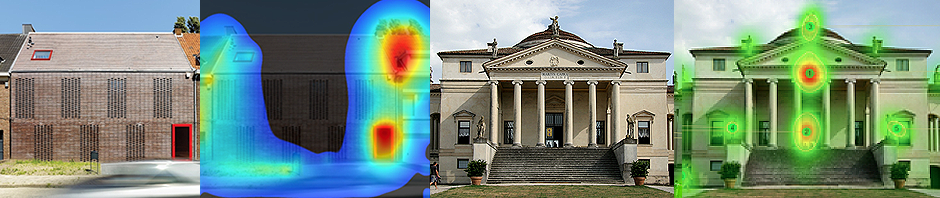
Eye Tracking the ‘Villa’: A First Step toward Understanding How We Experience Architecture
La Villa Rotunda by architect Palladio is, arguably, one of the most significant buildings in architectural history. Designed in the late 16th-century as a country house in Vicenza, Italy for a retiring cleric, its captivating elevations would go on to … Continue reading
‘Seeing’ How We Actually Look at Buildings at ABX 2016
Interested in ‘seeing’ your brain subconsiously take in the buildings around you? Then come to our talk Thursday, November 17th, at 1 PM at the Boston Convention Center, part of the ABX 2016 Conference. We’ll be presenting eye-tracking research from our recent … Continue reading
Posted in Uncategorized
Leave a comment
We See Like an Animal…and that Matters
Eye-tracking tools can help us see how we look out on the world as an animal – and it can help us understand why some buildings catch our attention while others don’t and never will. Check out the photos below: … Continue reading
Posted in Uncategorized
2 Comments
BSA Placemaking Network: Sept 26 Talk
The Biometrics of Placemaking: Why We Need Buildings to ‘See’ Us When:September 26, 2016 | 6:00 PM – 8:00 PM Where: Boston Society of Architects (BSA) Space, 290 Congress St, Suite 200, Boston Info: This event is free w refreshments and open to all … Continue reading
Posted in Uncategorized
Leave a comment
Eye Tracking for ANFA 2016 conference
The Academy of Neuroscience for Architecture (ANFA) hosts its fall conference, Connections: BridgeSynapses September 22-24 at the Salk Institute in La Jolla, CA. We’ll be sending along the poster below, the pilot-study of eye tracking Boston buildings, mentioned in a previous … Continue reading
Posted in Uncategorized
Leave a comment
The Genetics of Garden Design
Architecture is not just about houses and buildings—it’s also about gardens and landscapes. In the Genetics of Design, we write about how design affects biology and how biology affects design. Well-designed spaces make people feel comfortable and safe. They mesh … Continue reading
Posted in Biology, Design, Exercise, Health, People-centric Design, Walkability
Tagged Garden Design, gardens, Green Spaces, Health, Wellness
Leave a comment
How looking at Maggie can help us see Ourselves
In 1980, the psychologist Peter Thompson from the University of York published a one-page paper in the journal Perception, entitled “Margaret Thatcher: A new illusion.” In it he noted how psychologists know people struggle to read expressions on upside down … Continue reading
Posted in Uncategorized
1 Comment
Planning for the Subconscious
We’re thrilled to announce Planning Magazine, the flagship publication of the American Planning Association (APA), made our article their cover story this month. The story’s below, here’s how they introduced it: “This month’s Planning Magazine probes below the surface with an … Continue reading
Posted in Uncategorized
Leave a comment
Eye Tracking Architecture: a Pilot Study at the IHCD
In our pilot study at the Institute for Human Centered Design (IHCD), we used eye-tracking technology to understand how people respond to the built environment. Thirty-three test volunteers, aged 18 to 80, viewed more than 60 images of elevations and … Continue reading
Putting Faces First
After eye tracking a photo of the young man below, we saw how compelling a face could be. Within 3/10 of a second, the 33 people in our pilot study focused on his eyes and mouth. They proceeded to go back and look … Continue reading
Posted in Uncategorized
Leave a comment
 The Genetics of Design