Planning for People

First life, then spaces, then buildings–the other way around never works.” Jan Gehl

Aerial View of Somerville

Aerial View of Somerville’s Davis Square (Photo: Google Earth @ 2015 Google)

While Boston celebrated the start of the American Revolution on Patriot’s Day this week, the city of Somerville, two miles west, started a different kind of rebellion without firing a  shot.

Somerville, the densest city in the Northeast with 75,000 residents in four square miles,   held a historic public meeting called ‘People First Design Workshop.’ The goal: transform city planning by putting human habits and concern for their well-being at the center of the process.

The method? Use the game-changing techniques from Gehl Architects, the Danish firm that turned Copenhagen into the most walkable, bikeable city on earth where 50% of residents cycle to work and “many middle class families with kids don’t even own a car,” according to government reports. The Danish capital’s earned the ‘most livable city in the world’ award the past two years running.

“Who are you designing for… people or cars?” asked Jeff Risom, Partner and Director of Gehl Studio, the US branch of the firm, at the April 21st kickoff meeting at Somerville’s Old Post Office in Union Square. “Cities are for people” and design decisions should focus on “happiness and well-being,” he said.

Under the progressive leadership of Somerville Mayor Joseph Curtatone, the city hired Gehl Studios as part of their Somerville by Design initiative to reimagine the city’s environs, part of an ambitious agenda to build more housing, increase access to green space and improve the quality of public life. To figure out how people use existing space, Gehl’s team merges two disciplines: social science (tracking how people move about in urban areas) and design (form), and recruits dozens of local volunteers to take part in gathering the real-time community data.

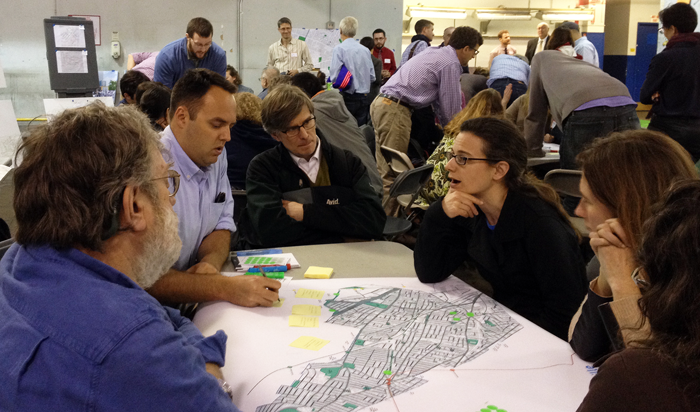
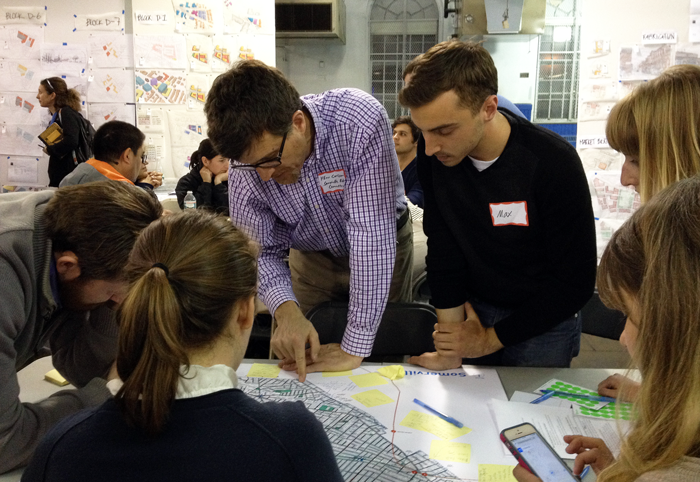
“In Somerville, 32% of the assets are streets. Who do you want to invite to use them? How do you want others to use the space?” Risom says. “Many people know how cars move; very few know how people move,” he said. “Information about how people use space [should] inform design decisions.” Workshop attendees provided some of their own data by marking-up maps of Somerville with favorite spaces, posting sticky notes with the qualities of their best-loved spots, and color-coding areas on the map that need improvement.

People First Design Workshop

Participants at the ‘People First Design Workshop’ in Somerville (Photo: J.M. Ward)

Later in May, the Gehl Studio team, working with Somerville’s planning department, will send observers into the field to find out how long people stay in a public space, whether all ages use the area, and if families take advantage of some places but avoid others. This feedback is key to understanding what people in a city need and where thoughtful planning can intervene.

Certain universal concepts have emerged from Gehl’s previous data collection in Copenhagen and other cities around the world. For example, people everywhere seek protection when outside (safe environment), comfort (in sun, shade and various weather conditions) and enjoyment (connection to other people, seating, places to talk and to be part of a network).

People First Design Workshop

Data Gathering at the ‘People First Design Workshop’ (Photo: J. M. Ward)

Ghel’s data collection results show that people don’t behave like computers or designers often expect. People move in a way they deem most comfortable, and they need continual stimulus.

People walk about three miles per hour, but their perception of the time it takes to walk anywhere varies depending on the extent of stimulus. We need one stimulus every four seconds, says Risom, and this helps explain why walking seems faster and more pleasurable when we can scan fresh fruit at the farmer’s market, smell the roses at the florist, admire the sparkling lights in the shop window or listen to a street band on the way to a train station.

Our trips are happier when we can find shade in summer and sunshine in winter. When congregating in a public place, we tend to spread out if possible, somewhere between 10 and 20 feet until we want to socialize, then we prefer three to six feet.

Detailed behavioral data collection in Somerville begins next month because it’s important each place be true to itself, Risom explains. The point is not to turn Somerville into Copenhagen, but to make Somerville the best it can be—as well as raise expectations about how a city can look and feel. “

At the end of May, an army of researchers [students and citizen volunteers]” will canvas the city with surveys to obtain more data, Brad Rawson from the City of Somerville Planning office explained. Gehl Studio designers will train those ‘Public Space, Public Life Survey’ volunteers on May 27 for the data gathering to take place on Thursday, May 28 and Saturday, May 30.

Volunteers will ask questions such as, “Where in Somerville needs more love? What qualities define your favorite space? Which public spaces do you use daily? What are the characteristics that make your favorite place feel, smell, sound or look good? Which public spaces need improvement?”

Want to spread the word? You can learn how to here: http://www.somervillema.gov/news/world-renowned-firm-hired-address-public-space-challenge

Then everyone will want to know who will be the next ‘Somerville’? (Or one down, 350 more to go!; there are 351 cities and towns in the Commonwealth of Massachusetts.)

By Janice M. Ward and Ann Sussman

Posted in Architecture, City Planning, Design, Health, People-centric Design | Tagged , , , | 1 Comment

Face-i-tecture

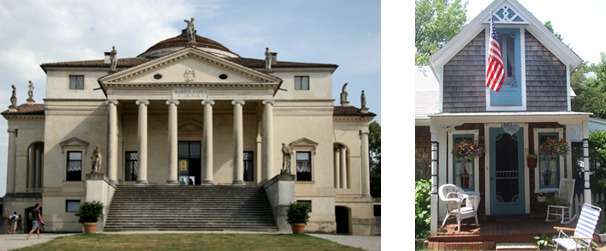
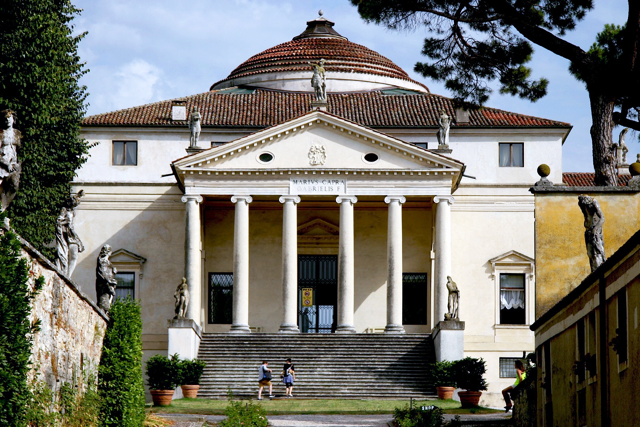
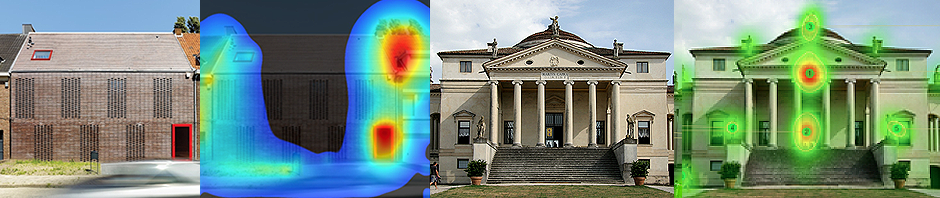
Do you see a face in Palladio’s Villa Rotunda? Do the windows on the second floor suggest eyes, and the portico a nose or mouth?  Or maybe the front door behind the columns represents the mouth, and the windows symmetrical about it, the eyes. Perhaps the pediment over the door frames the small ovals for eyes, and a central plaster cameo could be a nose or mouth.  And of course, there are lots of faces in all the statuary on the building.

Palladio's Villa Rotunda

Palladio’s Villa Rotunda (photo: Wikimedia)

Welcome to “face-i-tecture!”  The human brain is wired to ‘unconsciously’ seek out faces everywhere it goes, and this tendency slips over to what we build and what we revere.  Palladio’s villa, built at the end of the 16th century for a cleric in the Catholic Church, is deemed so important that the UNESCO declared it a World Heritage Site two decades ago.  We go to see this villa in Vicenza, Italy, celebrating it as one of the most famous and significant buildings in the history of world architecture.

But it also acknowledges something else: our face-obsession. The four identical elevations of the villa could be described as a ‘fugue to the face.’ And no wonder. Whether we like it or not, we are “face-i-tects” par excellence. One of the most amazing discoveries in recent neuroscience research is a more rigorous understanding of how face-obsessed we are as a species.  Primates are very visual—our ancestors evolved swinging from trees over millions of years, developing among other things depth perception that other mammals, like cows and horses, lack.  We also inherited something else: a keen ability to look at faces and read emotional expression—all without conscious effort!  The theory goes that if we hadn’t done this, we wouldn’t have survived as the social animals we are now.

Faces orient us from infancy on; they make us feel at home. And our new understanding of how faces pre-occupy our brain is leading to new understandings of why we build what we build, like what we like, and do what we do, spending hours watching YouTube videos, for instance, or bothering to buy selfie-sticks for our phones.  It can help explain why the Mona Lisa in the Louvre attracts some 7 million visitors a year. And, of course, it explains something deeper: how much we need to see each other—our survival depends on it.

by Ann

Posted in Uncategorized | Leave a comment

People Need Green Space

In 1970, Joni Mitchell sang “they paved paradise to put up a parking lot” to decry the lack of green space in the built environment. Since then, architects, planners and builders have expanded parking lots, widened highways and removed green spaces to accommodate larger buildings and extend sprawl. Turns out that Joni was right; we need that green space and the science now exists to back the claim.

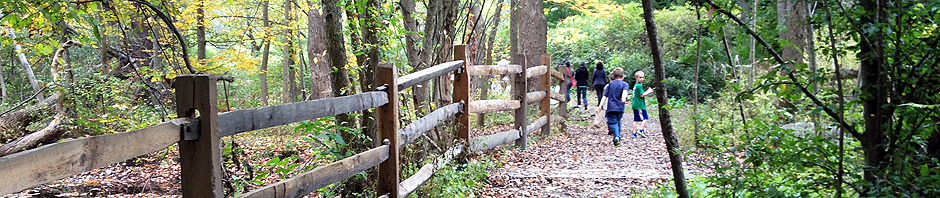
Acton Nature Walk

Acton Nature Walk (photo by J. M. Ward)

According to the Illinois News Bureau, the Science suggests access to nature is essential to human health for all ages. Children with learning disabilities like ADHD improve when the teaching environment includes outdoor activities; college students do better on cognitive tests when they study in a room with a view; and the elderly live longer when housed near a park or green space.  Richard Louv’s book, Last Child in the Woods, Saving Our Children from Nature Deficit Disorder, compiled large amounts of research correlating direct exposure to nature with the physical and emotional health of children and adults. Walking in nature, watching birds, and listening to frogs can reduce stress and anxiety, help decision-making and improve skill development. Louv not only presented the data, he offered solutions including removing asphalt and restoring nature to school yards.

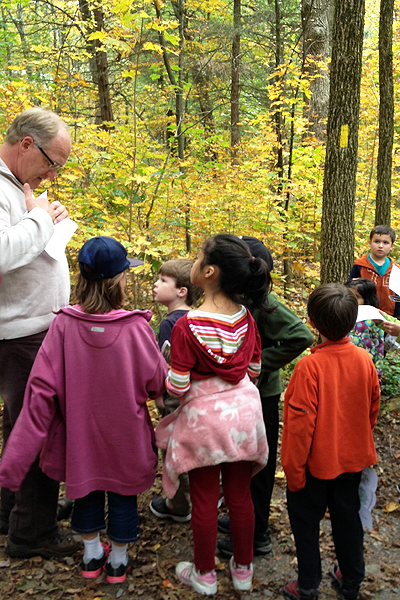
Nature Walk in Acton

Tom Tidman Led a Series of Nature Walks in Acton’s Conservation Lands (photo by J. M. Ward)

After reading Louv’s book, Eileen Sullivan, the curriculum specialist in Acton, Massachusetts, proposed adding natural spaces to the elementary schools’ playgrounds. During the proposal phase of the project, teachers from the Acton-Boxborough (AB) Regional School District and parents from the AB Parent Involvement Project (PIP) STEM read Louv’s book and engaged in a series of walks through Acton’s Conservation Lands with Tom Tidman, Director of Acton’s Natural Resource Department. The district drafted a proposal, received funding from the Community Preservation Committee (CPC) and hired a local landscape architect to design five nature play spaces.

In April 2015, the Town of Acton approved the construction of the nature play spaces at the elementary schools’ playgrounds.  Instead of traditional grass fields, hard tops and play structures, the schools will add a more natural environment for those students who are less interested in competitive games. The planners envision interactive spaces for children and adults during recess breaks and inspirational places for teachers and students to meet, talk, listen, write and draw. Construction will begin July 1, 2015.

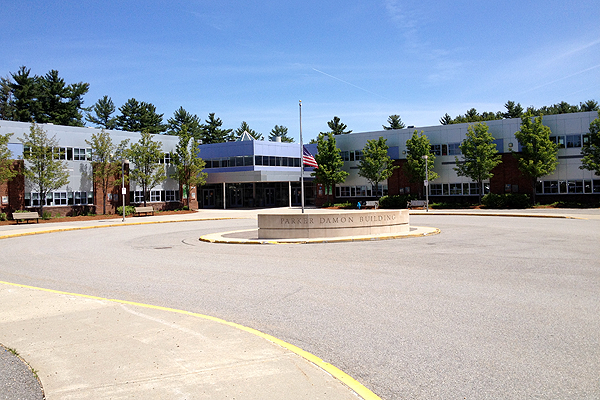
Parker Damon School in Acton

Entrance and Play Area at Parker Damon which Houses Two Acton Elementary Schools (photo by J. M. Ward)

An excellent start, but what about green space for all? Studies from the Center for Disease Control (CDC) have described healthy communities as more than just places with access to healthcare facilities, but towns with parks and sidewalks rather than tarmac and treeless streets.

The city of Somerville took notice. In March 2015, Somerville’s mayor, Joseph A. Curtatone, hired Gehl Studio, the U.S. based practice of Gehl Architects, whose founder Jan Gehl worked with the city of Copenhagen for more than 40 years to turn the Danish capital into a pedestrian and cyclist haven. More recently, Gehl did the same for NYC’s Time Square. Somerville by Design represents Gehl Studio’s user-friendly, people-centric approach to city planning.

“We’re rewriting the new Somerville Zoning Ordinance from the ground up,” says the mayor.  The new zoning will be a collaborative process with residents and business owners to share a new vision of Somerville. The design team continues to conduct interviews and workshops including “Green Spaces, Community Places” for residents to help shape their new work and play spaces. The goal is to “enhance our squares and corridors and transform underutilized areas into vibrant, walkable neighborhoods,” according to Somerville by Design.

The Annual Review of Environment and Resources cited, Humans and Nature: How Knowing and Experiencing Nature Affect Well-Being” which said, “The balance of evidence indicates conclusively that knowing and experiencing nature makes us generally happier, healthier people.” But it’s also clear that it takes a village to unpave paradise and remove those parking lots. Let the demolition begin!

By Janice M. Ward

Posted in City Planning, People-centric Design | Tagged , , , , , , | Leave a comment

Choosing Copenhagen.

Whenever Mark and I travel, we keep one eye open for that perfect place. Too many vacation spots feel like a nice place to visit, but we wouldn’t want to live there. Many of our empty nester friends have already found their ideal locales and have dispersed. Some moved to better climates, to be closer to family or farther away, to experience city life or retreat to the country. Perhaps we are indecisive or just plain picky New Englanders, but nothing has grabbed us so far. Neither Santa Fe nor Seattle nor Sarasota holds allure. The closest we’ve come is Copenhagen.

Nyhaven, Copenhagen

Nyhaven or New Harbor, a 17th-century waterfront, canal and entertainment district in Copenhagen
(Photo: J.M. Ward)

After returning from a vacation to Denmark, I shocked my friend Ann when I said, “I could live in Copenhagen.”  So, what was it about Copenhagen?

First, Copenhagen met our must-haves for a vacation spot—lively art and design center, fabulous food, a moderate climate and access to exercise. Then Copenhagen exceeded our list by showing us the wow factor—the lifestyle of a city designed for the health and well-being of its inhabitants.

Copenhagen’s claim to fame has always been its clean, modern Scandinavian design. The city does not disappoint—from the Danish Design Museum to the National Gallery of Denmark to the Danish Architecture Centre to the local furniture shops like Helbak. Lately design has made room for foodies who flock to the city for foraged food and a nosh at Noma, the world’s best restaurant, which was a tad too pricey for our tastes. But we found terrific homemade Norwegian food throughout the city, which we also chose for climate. Mark doesn’t care for hot weather, so the similarity of Copenhagen’s weather to New England’s was a plus. But the real draw involved the Danes’ humanist approach to city planning—a design that prioritizes fitness, health and physical mobility.

Pedestrians in Copenhagen Center

Pedestrians in Copenhagen Center (Photo: J.M. Ward)

Copenhagen is a paradise for walkers, cyclists and runners because most Danes do not rely on cars. Unlike our car-centric country, pedestrians in Copenhagen have the right of way, followed by bicycles, followed by autos. Bike lanes line every street and 50% of the residents bike to work daily.

The bikes we rented in Copenhagen were the kind of three-speed vehicles we remembered from childhood. Handle brakes. Comfy seats. Metal baskets. Shiny silver bike bells. Brrring. Brrring. The pace of biking in Copenhagen was neither breakneck nor leisurely, but purposeful. Bike to market. Bike to work. Bike home. And Copenhagen is completely set up. Baskets to carry groceries. Carriers or trailers to cart children. Racks for parking.

Cycling in Copenhagen

Cyclists in Copenhagen outside the Pottery Shop, Helbak (Photo: J.M. Ward)

During our Copenhagen vacation, Mark and I replaced our daily trip to the gym with cycling, walking and running outdoors everywhere every day. We happily chose bicycles as our main mode of transportation for the entire trip. Not only were bike lanes available on all the city’s streets, but all the constituents (walkers, bikers, and drivers) followed the rules of the road. Stop on red; go on green. This adherence to the traffic laws made it extraordinarily safe to ride bikes in the city. Expectations were set; no road rage anywhere. And Copenhagen continues to improve the bikeways. In June 2014, Copenhagen opened a new bike skyway, an elevated roadway for cyclists over the harbor. Conversely, in our nation where car is king, the Center for Active Design reports that the explosion in obesity is a direct outcome of our ubiquitous, car-dependent neighborhoods.

Greenhouse at the Botanic Gardens, University of Copenhagen

Greenhouse at the Botanic Gardens, University of Copenhagen (Photo: J.M. Ward)

When the residents of Copenhagen were polled recently about their reasons for biking, 54% said cycling was “easy and fast,” 54% noted the need for “exercise,” 6% said cycling was “cheap,” 7% liked the “convenience,” and 1% wanted to save the “environment.” In their leisure time, Danes enjoy exercising in the proliferation of parks and beaches in Copenhagen. The circular Crystal Palace greenhouses at the University of Copenhagen’s Botanical Gardens in the center of the city are available to all, and the city plans to make it a priority that all residents can access a green area within 15 minutes of their homes by 2015. My favorite place to jog in Copenhagen was an elevated star-shaped running path at Kastellet, which was originally a fortress to protect the city. Each tip of the star holds a vista—the harbor, a church, a windmill, a fountain, a castle. Other green initiatives by Copenhagen city planners encompass an even more ambitious goal—to become the first zero-emissions capital in the world by 2025. The byproduct of this sweeping attention to fitness and health in Denmark is a happy population.

Running Path at Kastellet, Copenhagen

Running Path at Kastellet, Copenhagen (Photo: J.M. Ward)

The Danes got it right. From an evolutionary standpoint, humans were born to exercise. Our bipedal ancestors survived by walking, jogging and running away from prey and toward food. Emerging scientific data “suggests that we are clever today in part because a million years ago, we could outrun and outwalk most other mammals over long distances. Our brains were shaped and sharpened by movement, the idea goes, and we continue to require regular physical activity in order for our brains to function optimally,” according to the New York Times AskWell blog, Exercise and the Ever Smarter Human Brain.

As for living in Denmark, the Danes I met in Copenhagen were bilingual and had such an excellent command of English, I could not tell they were non-native speakers. Even though I don’t know Danish, I still contend that I could live in Copenhagen—except that work, family and friends are here.

Copenhagen

Walking and Dining in Copenhagen (Photo: J. M. Ward)

So I have to ask myself, why don’t we have easy access to restaurants and shops? Where are our sidewalks and bike trails? Why do drivers disregard pedestrians and cyclists? How come road rage persists here, but is virtually nonexistent over there? Why aren’t our city planners making healthy communities a priority? Can Americans redesign cities to embrace walking and biking? Why can’t we learn from Danish design to create that perfect place?

More articles on Copenhagen include:
Copenhagen: Design City
Can America Embrace Biking the Way Denmark Has?
Copenhagen–leading-the-green-city-revolution

By Janice M. Ward

Posted in Architecture, City Planning, Cycling, Exercise, Health | Tagged , , , , | 3 Comments