Faces of Japan

Have you ever looked at a house and felt it was looking back? Did the windows, doors and threshold resemble a friendly face? Now that I’m attuned to our subconscious bias for faces, I’m on constant lookout for buildings that suggest a face or face-i-tecture. A recent trip to Japan highlighted just how much our brains recognize face-like designs on buildings and streetscapes to help us feel at home.

Shrine Near Mount Fuji

Shrine at the top of Mount Komagatake, an observation point for Mount Fuji

The Hakone Shrine Mototsumiya smiles down from the top of Mount Komagatake which offers magnificent views of Mount Fuji. Visitors reach the top via a 1,800 meter aerial tramway in Hakone National Park. Although this shrine was built in 1964, the Japanese have a long history of building temples with a similar visage. It’s amazing how this powerful building welcomes visitors—transcending language and cultural barriers.

Todaji Temple in Nara Park

Todaji Temple, Built in the Nara period (710-794AD) for the Emperor Shomu

About 200 miles west of Mt Fuji, a much older temple in Nara Park offers a similar welcome on a grander scale. You can almost tell from its look that Todaji Temple is a place of prayer and peace. As a center for Buddhist doctrinal research, many visitors come to practice meditation techniques as the way toward enlightenment.

This temple was damaged and repaired over the centuries, and the current building ranks as the largest wooden structure in the world. Perhaps face-i-tecture in a building, making it seem more human and easier to connect with, makes the community more interested in repairing and rebuilding over the centuries.

Traveling southwest toward Kyoto, I found smaller buildings with similar expressive facades, such as the ones below. Kyoto is the center of Japan’s cultural, spiritual and artistic heritage with more than 2,000 temples and shrines including 17 that are UNESCO World Heritage Sites.

Japanese Hall near Kyoto

Small Japanese Hall with Pleasing Facial Expression at Ryoanji outside Kyoto

Japanese Pagoda

Pagoda near Kiyomizu Temple in Kyoto shows Chinese Architectural Influence and Smiling Face

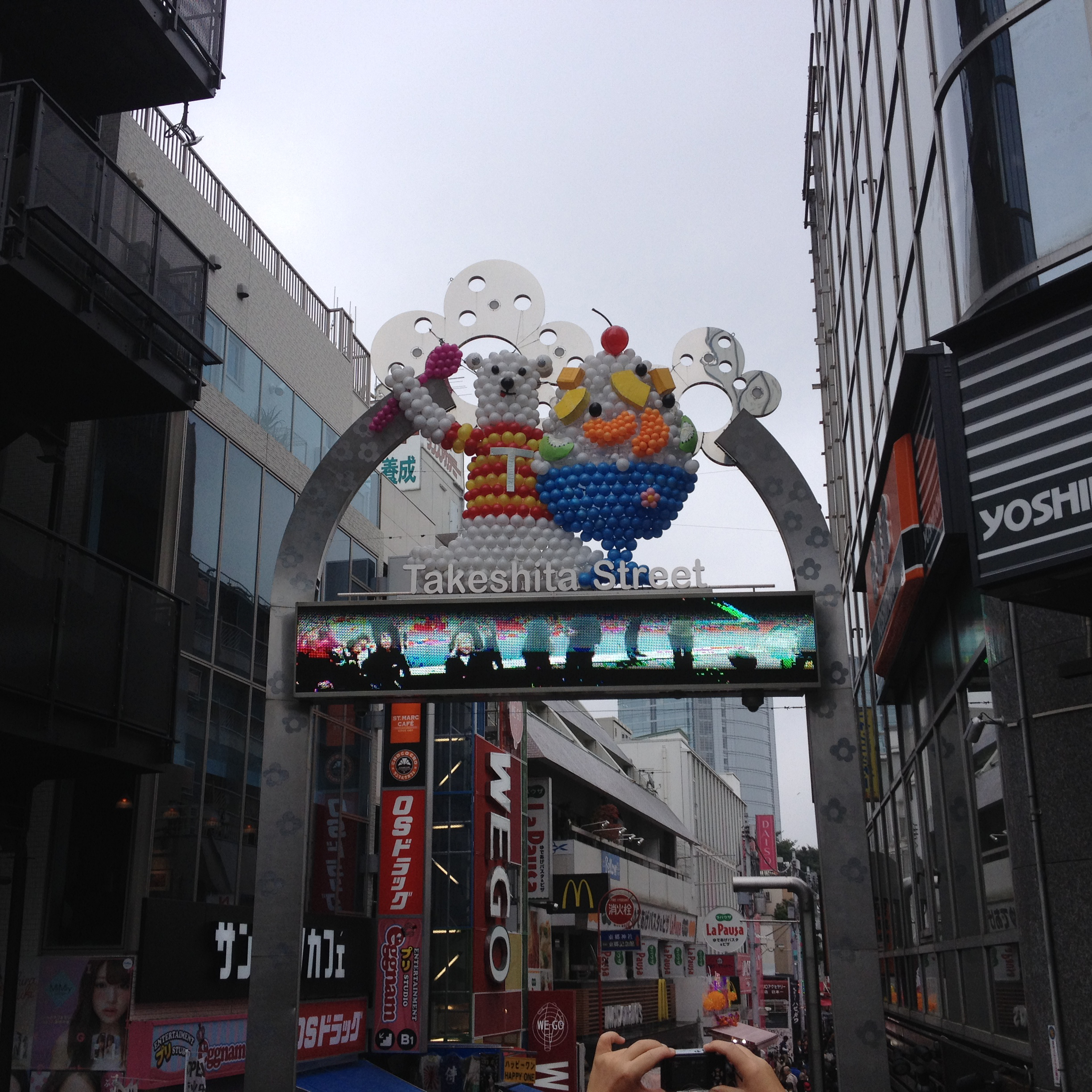
Though face-i-tecture is missing from high rises in modern Japanese cities, that does not diminish our need to see and be seen by faces. In new construction, it seems that local builders, designers and marketers sensing our face bias, install statues, cartoons and other facial animations to keep people subconsciously engaged in the modern streetscapes. For example, in the shopping area favored by teens in Tokyo (below), notice the animal statue and visual billboard that videos and broadcasts shoppers’ visages as they walk toward the stores.

akeshita Street in Tokyo

Statues and Digital Billboard on Takeshita Street in Tokyo

Opposite Tokeshita Street, anime billboards designed as instructional devices for teens use anime to warn about the dangers of sharing passwords on digital devices.

Anime Billboard

Anime Billboard outside Harajuku Station opposite Tokeshita Street Shopping District

Meanwhile at GinzaWorld in downtown Tokyo, the face of “Hello Kitty” greets customers outside the Sanrio store. According to our Japanese Guide, women who work in offices often buy Hello Kitty stuffed animals for their desks—putting a fun face on worktime.

Hello Kitty in Tokyo

“Hello Kitty” greets customers outside the Sanrio Store in Tokyo

Now that’s face-i-tecture par excellence, helping us connect to our surroundings and feel more at home wherever we are, whatever language we speak.

Writer: Janice M. Ward
Editor: Ann Sussman

Posted in Architecture, Patterns, People-centric Design | Tagged , , | 1 Comment

The Joy of Modern Houses

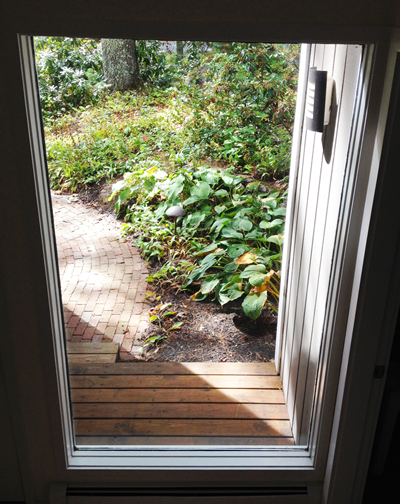
The first time I toured a modern house, it was love at first sight. Heart racing. Pulse pounding. Face flushing. Love. Or maybe lust. Either way, once I met a house with cathedral ceilings, I never went back. Humongous windows. Outstanding views. Asymmetric layout. Open floor plan. Sleek styling.

Modern House Entry

Modern House Entry, Photo: J. M. Ward

The year was 1975; rock and disco were duking it out on the radio, and computers were not yet mainstream when I first viewed that modern house. Picture the scene in slow-mo. Our heroine turns the stainless handle, carefully opens the mahogany door and catches her breath as she walks into an airy delight with a two-story teal accent wall beside transparent stairs that ascend to heaven. Enormous skylights. Unrestricted space. Light-filled areas. The epitome of indoor-outdoor living. Love at first sight.

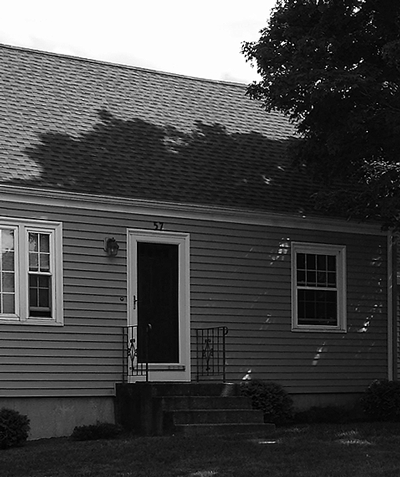
Modern houses aren’t the first choice for most New Englanders, and my parents were no exception. Many Bay State homeowners fall into one of two camps: Cape Cod or Colonial. I was raised in a traditional New England home—a classic cape with gray shingles and black shutters.

Traditional Cape Cod Style House

Traditional Cape Cod Style House, Photo: J. M. Ward

Our house looked like every home a child draws in the second grade: pitched roof, rectangular body, chimney on the side, symmetric layout, mullioned windows, flag stones leading straight to the painted front door. Insert a few shrubs under those windows and voila! The front door opened to a staircase with living room on the left and dining room on the right. Visitors could walk through the living room or dining room to reach a back hall which connected a bedroom, bathroom and kitchen—a perfect square. Not hip or cool at all.

In time-honored New England fashion, my dad added on, renovated and rejiggered to make it his own. A knotty pine porch here, a combination workshop/office/playroom there. Honey maple and a penchant for bronze eagles rounded out his design. Homey, sure. But exciting? Heart pumping? Fun? I think not.

My architect friend and fellow blogger writes a lot about people liking houses that are anthropomorphic and seem to ‘call out to you,’ suggesting a face. “Since we are biologically predisposed toward faces since birth,” says Ann, “symmetrical design feel comfortable to most people. It responds to their need for fast orientation.”

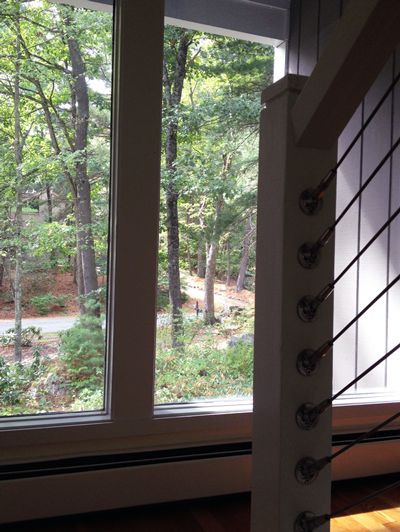
Modern House Stairway

Modern House Stairway; Photo: J.M. Ward

But I say, not so fast. We not only judge houses based on views from the outside-in; we judge houses based on the views from the inside-out. So our preferences are complex. Even though humans may prefer symmetry; they are also partial to an abundance of natural light and a connection to nature; characteristics that modernist homes display in spades.


Humans evolved with a preference for natural daylight for safety, and lately, as an antidote for depression. The older we get, the more natural light helps us with day-to-day tasks at home and at work. A recent study quoted in Science Daily, “highlights the importance of exposure to natural light to employee health and the priority architectural designs of office environments should place on natural daylight exposure.”

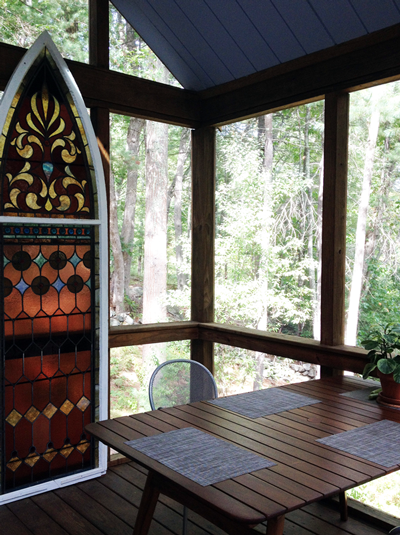
Modern House Porch

Modern House Porch; Photo: J.M. Ward

Researchers tell us that early humans looked to trees for sanctuary and protection long before they built huts as homes. Our evolutionary biases lean toward greenery, outdoors and nature which modern houses provide with those sliding glass doors leading to decks and beyond.

As I see it, home is where the heart is—no matter how evolved the human race becomes. And my heart belongs to cantilevered rooms, casement windows, cable railing systems and sliding doors that lead down curvy paths, meander through green gardens, and take me to sunny skies.


Writer: Janice M. Ward
Editor: Ann Sussman

Posted in Architecture, Design, Health | Tagged , , , , , | 1 Comment

Architecture that Calls to Us

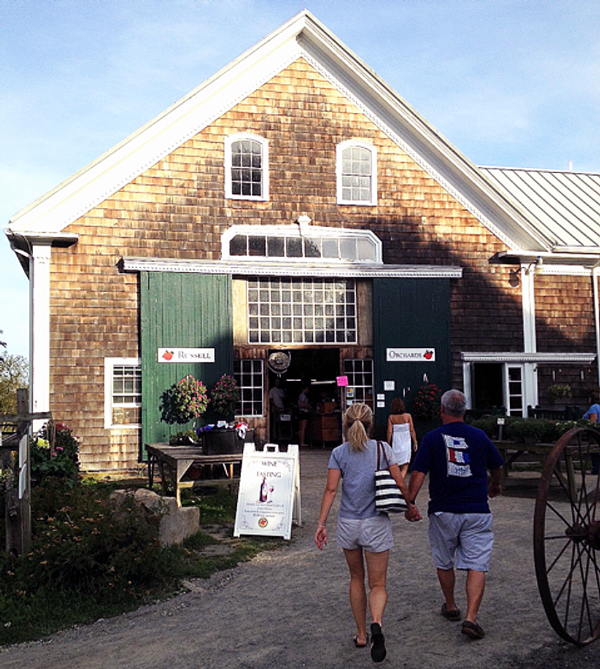
I was heading to the beach the other day when I saw this barn at a nearby local orchard, and I knew I’d have to stop by.

Architecture that Calls to Me

A Barn with a Face that Called to Me; Photo. A. Sussman

The barn seemed to have wide eyes that met my gaze and called out to me. So I made a mental note to leave the seaside early since it seemed I had a date!

And when I did get to the old building later, I saw that its face was prominently used to market the place!

T-Shirt with Barn Photo

T-Shirt with Front Facade of Barn with Face; Photo: A. Sussman

The farm was selling T-shirts emblazoned with the barn’s front facade plus two or three additional face-like patterns. Employees were wearing them. Clearly, I wasn’t the only one drawn in.

Then on the drive home, I saw that a local prep school had just put up this new school sign in several places around its campus.

Concord Academy Sign

Sign with Face-like Building; Photo: A. Sussman; Sign by Crosby Design

Another face to promote a place!  Whether marketing cider donuts or something lower calorie, it appears you can’t beat this pattern to grab people.  This is of course exactly what Mother Nature has intended – she’s been doing the same thing, turning animals into sensitive ‘face-i-tects’ for millions of years – and it turns out following her rules for what she intends you to look for first often carries big dividends.

Writer: Ann Sussman
Editor: Janice M. Ward

Posted in Architecture, Patterns | Tagged , , , | Leave a comment

Drives Me Crazy

Donna called at 5pm with a last-minute request, “Can you give me a lift to Bedford? I promised to have dinner with my parents and my car’s in the shop.”

“Sure” I said, not realizing that a 10-mile drive during rush hour takes 45 minutes each way.

Not only was Donna’s car in the shop; husband Glen was driving his car home from a business trip; and daughter Amy needed a car to move into her new dorm. That’s right, three cars in a three-person household. Welcome to the burbs!

Acton Parking Lot

Parking Lot in Acton, Massachusetts, Photo: J. M. Ward

Living in Acton, Massachusetts, a small town 25 miles west of Boston, means driving—everywhere. The mass transit commuter rail takes us to Boston, but not Bedford or Burlington. The last census revealed that Acton residents own 1.8 cars per household. We have to. Nothing is within safe walking distance. Not even the local market. We even have to drive to the gym.

In our community, suburban living means limited public transportation, limited walkability for health and wellness, and limited socialization because of isolation. A total dependence on cars.

I blame Ike.

Fifty years ago, Dwight D. Eisenhower signed the Interstate Highway Act that created a nation dependent on automobiles. To this day, our train and bus infrastructure is weak, our sidewalks and bike paths are minimal, and we remain slaves to the auto. At what cost? Our health and wellness.

Acton Traffic

Acton Traffic, Photo: J. M. Ward

A recent study from the American College of Sports Medicine showed that Americans walk less than their counterparts in Switzerland, Australia and Japan. Their results conclude that “Low levels of physical activity are contributing to the high prevalence of adult obesity in the United States.” A subsequent story from Slate Magazine reveals “How We Got Off the Pedestrian Path” in The Crisis in American Walking. “Walking has been engineered out of existence,” cites Tom Vanderbilt, mainly because of the car.

The chart below comes from the American Public Health Association (APHA) website which compares Americans’ health with other high-income nations.
In life expectancy, we rank 34th!

American Public Health Association

Chart from the American Public Health Association (APHA) at http://www.alpha.org/HealthiestNation

After 50 years of highway driving, do we even know how much walking would put us on the right path? The New York Times revisits “how many steps a day we should really walk?” Given the state of American health, the common benchmark of 10,000 steps per day may be too low. At 2,000 steps per mile; 10,000 steps or five miles per day might not be enough. And we are missing a prime component—infrastructure. Sidewalks and bike paths fell by the wayside when the car became king, and our health has suffered from it.

What if we labeled unwalkable neighborhoods like we do cigarettes?” suggests Smart Growth America, a website dedicated to promoting walking and physical activity as a built-in feature of communities.

This week, the Surgeon General of the United States answered the call by kicking off a campaign called, Step It Up! The Surgeon General’s Call to Action to Promote Walking and Walkable Communities. The Step It Up! website includes additional resources such as tips on How to Start a Walking Program and an easy way to add a little music to our walks with the Surgeon General’s Walking Playlist Exit disclaimer icon on Pandora.

Surgeon General's Step It Up Campaign

Surgeon General’s Step It Up Campaign

With over 47,000 miles of interstate highways connecting car-centric communities, how do we reverse Ike’s unintended consequence of an unhealthy nation? Let’s tell Congress to listen to the Surgeon General by making walkable communities a priority in the next transportation bill and just keep walking!

While waiting for Congress to act, Donna and I will probably still be sitting in traffic. Maybe we could walk there faster!

Empty Acton Sidewalk

Empty Acton Sidewalk beside Route 27 Traffic, Photo: J. M. Ward

Writer: Janice M. Ward
Editor: Ann Sussman

Posted in City Planning, Exercise, Health, Walkability | Tagged , , | Leave a comment

The Allure of Repeated Patterns

The main draw of the new Broad Museum slated to open in Los Angeles on September 22 is the eye-catching pattern on the building’s skin. Humans are captivated by repeating patterns: dots, diamonds, circles, cross hatches, ovals, stripes, spirals, scallops, stars, triangles, wavy lines, zig zags, and hexagons.

We doodle them during boring meetings, design them into quilts, and create tile mosaics that can last for centuries. Patterns evoke emotional responses from us, mostly positive, but not always. Think about a honeycomb shape and a fear of bee stings.

The Broad Museum

The Broad Museum in LA, Photo: Iwan Baan from thebroad.org

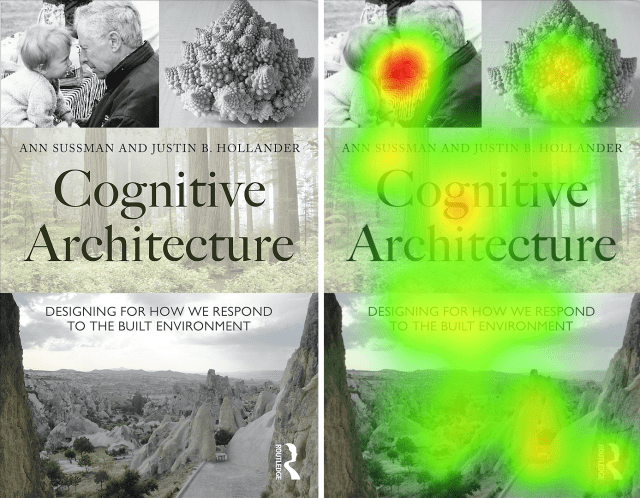
“We have evolved to register and investigate and prefer certain forms over others in fractions of a second,” says Ann Sussman and Justin B. Hollander in their book, Cognitive Architecture: Designing for How We Respond to the Built Environment.  “In those brief moments our brain can subconsciously determine whether or not to flee or step forward well before our conscious mind gets into the act.” For our ancestors, sharp objects represented danger while curved surfaces felt safe. Pattern recognition is key to survival.

While curves represent safety over sharp pointy objects, we also like symmetry which is so similiar to the bi-lateral symmetry in faces. Symmetry also appears in repeating patterns and appeals to our desire for balance. The photo below shows the symmetrical layout and repeating patterns in the dome and wall tile at the Topkapi Palace in Instanbul.

Topkapi Palace

Dome inside the Topkapi Palace in Istanbul, Photo: J.M. Ward

Our brains find special meaning in patterns from our natural habitat. Since we evolved as hunter/gatherers on the Savanna, patterns from Mother Nature hold innate appeal.

Pattern recognition happens when we match something we see to something in our memory.  We evolved to recognize patterns as a survival characteristic to distinguish the danger of the spots on a leopard or the hexagons of a beehive in a fraction of a second.

All we need is a quick scan to verify dots on leopards, stripes on tigers, cross hatches on branches, ovals on petals, spirals on shells, triangles on hills and trees, wavy lines on sand dunes and mountain ranges, and hexagons on bee hives.

Ephesus Mosaic Floor in Terrace House

Mosaic Floor in Ephesus Terrace House (1BC to 7AD), Izmir Provence, Turkey, Photo: J. M. Ward

Instinctively, we adapt, translate and extrapolate these natural patterns into our own designs.  Think about your favorite buildings. The best designs not only rely on form; they trigger your pattern-matching skills. A key reason we like the Acropolis in Greece is because it looks like trees rising in a forest.

Acropolis

Acropolis in Greece, Photo: Wikimedia

Our admiration for Dulles Airport (designed by Eero Sarinen) in Washington is peaked by its evocative wavelike canopy that resembles the ocean or dunes.

Dulles Airport

Dulles Airport, Architect Eero Sarinen, Photo: Wikimedia

The popularity of the pyramids lie in their resemblance to mountaintops.

Louvre

Pyramid at the Louvre, Paris, architect I.M. Pei, Photo: Wikimedia

Humans evolved to recognize forms and patterns, and the most successful architecture uses both.

So the next time you find the margin of your notebook filled with dots, doodles and squiggles, don’t worry; it’s just your unconscious working overtime.

Posted in Architecture, Design, Patterns | Tagged , , , | 1 Comment

No Faces – We’ll Affix That!

How We Add Faces to Blank Places

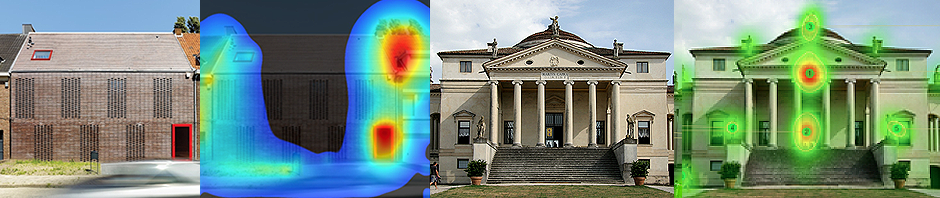
Humans are drawn to faces. Our brains are built to see them. Indeed, more of our brain is engaged in facial recognition than the recognition of any other visual object, says neuroscientist Eric Kandel in The Age of Insight. Even face-like houses with windows for eyes and doors for noses attract us. So what happens when public buildings lack a face-like facade?  Sooner or later, they’ll get one.

My recent article in Metropolis on Why Brain Architecture Matters for Built Architecture describes how our hard-wired obsession with faces spills over to what we create and admire. It’s a reflection of the fact that we see the world—like an animal—which makes sense, of course, because we are one.

Our brains favor fast orientation, and nothing quite gets to us like that bilaterally-symmetric shape with central door and windows neatly arranged on either side.  We find it reassuringly familiar.  It’s been orienting us since birth.

You can see the pattern very effectively at work in Palladio’s famous Villa Rotunda in Vicenza, Italy as well as in the simpler, but endearing, cottages in Oak Bluffs, Martha’s Vineyard, built more than three centuries later.

Buildings with Faces

Palladio’s Villa Rotunda in Vicenza, Italy (left) and a cottage in Oak Bluffs, Martha’s Vineyard, Photos: Wikimedia

Both places, interestingly enough, are legally-protected historic sites.  People don’t want to change or demolish them because we like the way they seem to see us, even care about our existence. And we care about them.

When facades don’t comply and buildings, especially civic ones, get too abstract or simply dull, something strange often ends up happening:

                                  They get a face!  It happens like magic.

Usually it’s a cartoonish face or a photograph. Generally, it’s got nothing to do with the architecture—but, of course, the face grabs our brains anyway.  It’s what evolution, the most powerful designer on the planet, built us to look for, and we can’t escape it.

Here are some favorite examples.

  • The Contemporary Arts Center in Cincinnati

Below are the “before and after” pictures of the Cincinnati Arts Center. The 2003 building (far left in photo), designed by ‘starchitect’ Zaha Hadid, apparently didn’t lure the public in the way it might, so curators permantently installed a sculpture with a neon face by the front door in 2014. (see photos at center, right) I can’t quite call it fine art, but the ‘robot’ did get me to take a second glance at a facade that otherwise gets lost in the jumble of a city block. It makes the building feel friendlier.

The Contemporary Arts Center in Cincinnati (original building on left; with art installation on right) Photos: A. Sussman

The Contemporary Arts Center of Cincinnati  (original building on left; with art installation on right), Photos: A. Sussman

  • San Diego Marriot

San Diego Marriott

San Diego Marriott, Photo: A. Sussman

A simpler case in California shows large faces of comedian Conan O’Brian affixed to the Marriott near the San Diego Convention Center before the Comic-Con International festival this past July.  In this case, it’s a temporary installation—and it certainly grabs your attention and gets you to look up, in ways the plate glass monolith doesn’t.

  • Boston City Hall

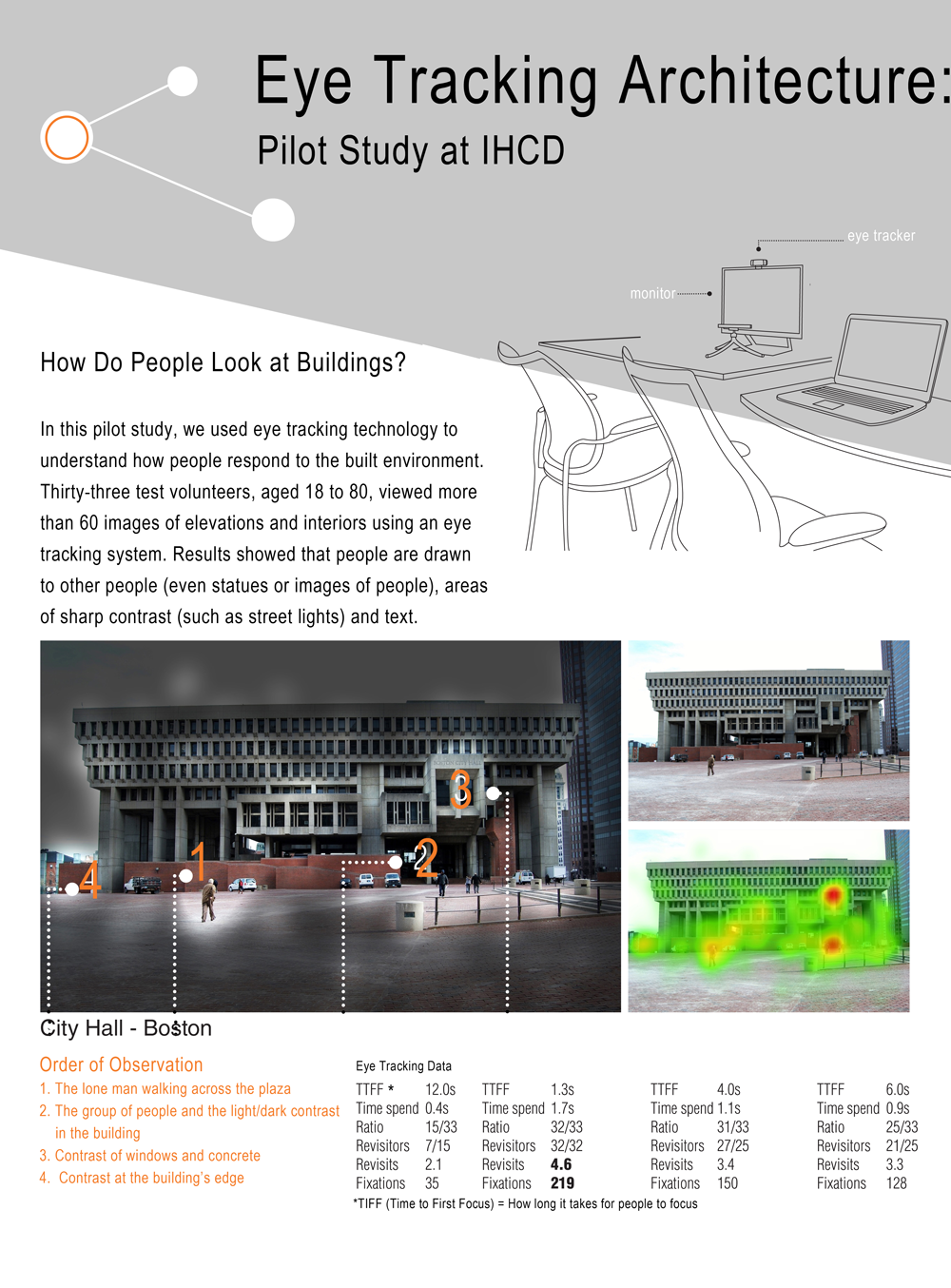
Below are pictures of Boston City Hall, a famous brutalist structure. Boston Mayors have long tried to broaden its appeal. In 2002, the face of former Boston Mayor John Collins, in office when the building went up, was permanently affixed near the entry, more than thirty years after construction.

This year, Boston’s new Mayor, Marty Walsh, greatly expanded the facial theme on the front elevation by adding more than a dozen faces directly to the entry facade. This ‘Welcome to Boston’ photo montage appears to be a semi-permanent installation.

Boston City Plaza

Boston City Plaza, Top Photos: Wikimedia, Bottom Photo: A. Sussman

  •  Bilbao Museum

Bilbao

Bilbao, Photo: Wikimedia

My favorite, however, may be outside Frank Gehry’s famous Bilbao Museum.  Jeff Koons’ Puppy Face was placed at the entry—before this museum in Spain even opened to the public in 1997. How can we not feel happy when taking in a baby animal face?

Although, come to think of it, when I look back in time, I have to admit, the one below, not quite as cuddly, is riveting, too. It really defines the genre.

It’s a shot of one of the Pyramids at Giza, Egypt, with the Great Sphinx in front.  The pyramids are about 5000 years old, and the Sphinx of similar vintage, shows the mug of a long-ago pharaoh who’s definitive identity appears lost in the sands of time.

Sphynx

Sphynx, Photo: Wikimedia

If you have a favorite example of a face-affixed building, send a photo along.  It’s fun to consider how a simple face changes how we attach to and remember a place.

Ann Sussman, Writer

Janice M. Ward, Editor

Posted in Architecture, Design | Tagged , | 2 Comments

The Primal Vista: Why We Crave Water Views

Every summer, Mark and I reserve one vacation week for a trip to the quaint Cape Cod town of Wellfleet, Massachusetts. No chateau in Chinon, palazzo in Paris or castle in Cardiff, just a few rooms with a view—an ocean view.

Wellfleet Harbor

Duck Creek, Wellfleet Harbor, Photo: J. M. Ward

Like many New Englanders, we start our pilgrimage with a stress-filled drive down Route 128 in bumper-to-bumper traffic before crossing the Sagamore Bridge over the Cape Cod canal.  After the first whiff of salt air, sight of brush pines and glimpse of bay views, everything changes. We relax and start to fantasize about owning a cottage overlooking the beach.

Why are we so taken with ocean views?

It turns out that water views tap into what our brain truly wants to see.

Wellfleet Beach

Indian Neck Beach, Wellfleet, Photo: J. M. Ward

Biologist E.O. Wilson writes that humans evolved with a genetic predisposition for nature which he calls “biophilia” and with that comes an “innate attraction to water, distant views and lush vegetation.” Our ancestors lived in the African, European and Asian savanna, so we arrive in this world hard-wired to appreciate sandy expanses, scattered trees and water views—just like those on Cape Cod.

This primal vista feels safe and familiar because we are descendants of hunter-gatherers who needed to see clearly if approaching animals or fellow humans were friend or foe, find sustenance near water and escape the elements beneath trees.

And it’s not just New Englanders seeking water views. “The magnetic appeal of beautiful landscapes [similar to savannas]” attract “people in very different cultures all over the world,” says Denis Dutton during a 2010 TED talk called A Darwinian Theory of Beauty. He described these preferred landscapes in terms of a Hudson River School aesthetic with “open spaces, covered with low grass, interspersed with trees. And if you add water to the scene—either directly in view, or as a distant bluish cast that the eye takes as an indication of water—the desirability of that landscape skyrockets.”

Marine Biologist, Wallace J. Nichols says, “We know instinctively that being by water makes us healthier, happier, reduces stress, and brings us peace” then he takes it one step further. By using brain scanning hardware and eye-tracking software, he tests the brain’s response to watery stimulus and describes the results in his book, Blue Mind: The Surprising Science That Shows How Being Near, In, On, or Under Water Can Make You Happier, Healthier, More Connected, and Better at What You Do. His mission? To “consider a fundamental question: what happens when our most complex organ—the brain—meets the planet’s largest feature—water?”

Whitecrest Beach, Wellfleet

Whitecrest Beach, Wellfleet, Photo: J. M. Ward

So without realizing it, I now see that our annual expedition to the Cape is based on our genetic predisposition for the water views of our ancestral home and a self-preservation mechanism from a stressful world. Rested and restored after a week on the Cape, I set aside my fantasy of beachfront property—until next summer—and tape those ocean view photos above my desk. For when we dream about our idealized future, we are really seeing our ideal past.

Janice M. Ward, Writer
Ann Sussman, Contributor/Editor

References:

Cognitive Architecture: Designing for How We Respond to the Built Environment, by Ann Sussman and Justin B. Hollander

Why our brains love the ocean: Science explains what draws humans to the sea” by Wallace J. Nichols in Salon Magazine.

Posted in Biology, Health, Primal Vista | Tagged , , | Leave a comment

Why We Love Buildings that Look at Us …

A few months ago, I attended an unusual high school reunion.  It was a special ‘tea’ for the alumnae of a girl’s high school which was getting its first major renovation in more than fifty years—and the grads were invited to see the plans. The school had gone co-ed, merging with a boy’s school in 1974, so the youngest of the more than 40 alums who turned up was about 60, and many were a decade or two over that.

Their concern for their old campus was heartwarming, and yet I couldn’t help wondering what really brought them out. The women took in the plans for the new additions politely enough, but the renderings for the new addition, while attractive, didn’t draw any questions. It became clear that what the grads really wanted was reassurance about one thing: would the original old buildings remain?

BBN

From the left; Buckingham Carriage House and Original Building, Cambridge, MA, (today’s Buckingham, Brown & Nichols Middle School.) Photo: A. Sussman

“Yes,” the alums were told that the 19th-century house and carriage building would still stand but additions from the sixties would be demolished and replaced with newer ones. Everyone seemed delighted. But why did the alums not mourn the loss of those earlier additions that they’d used? These buildings had provided some of the more serviceable classrooms and homerooms for decades. What was it about the century-old buildings in the front and side yards that hooked them emotionally forty or sixty years later (some alums were from the class of 1950)?

In some ways, the answer is simple and straight-forward and one could say, right in front us: the antique buildings suggest a face and, no surprise, provided ‘the face’ of the school for generations. These structures are rigorously bilaterally symmetrical with windows that suggest eyes and doors that could be a nose or a mouth. They not only instantly orient us, they quite significantly also anticipate our perennial need for orientation, and in so doing seem to acknowledge our existence. The old facades say, “Hello, I see you and think you’re very nice.”  Or, “Hi there, I’m here for you and always will be.”

Day in and day out, the old edifices work hard to meet our intrinsically human pre-conscious requirements for recognition and connection. The human brain as an animal brain has no choice but to look out at the world as an animal, which means we’re on alert for survival, continually at the ready to see other animals that could be in our midst. (We evolved in the wild, where the behavior’s requisite.) Our eyes are not consciously controlled for the most part, indeed, more than 90 percent of our brain activity is outside of conscious awareness. So when we look at buildings that suggest a face, hundred-million-year-old habits kick in. We start to feel a connection, maybe even a little love, or at least in relationship with the object. We ‘reify’ the building, or begin thinking that it’s real. (Car manufacturers design to this feature, especially the front headlight view.) No wonder, then, that the alums showed up; they had to. They cared. With no conscious instruction, their brains had bonded to two of the school’s front-ends.

And what about the new addition? The new tall, glassy construction, may never elicit the same behavior from alums, whether five, ten or fifty years from now. No matter how appropriately appointed  the interior educational spaces turn out to be, the primal pattern isn’t there. It doesn’t have a distinct ‘face.’

BBN New Addition

New addition; BBN Middle School: photo: Austin Architects.

The same holds true for the high school’s main entry building on another part of the campus (shown below). So when the Board of Trustees hold a coffee about its renovation in say, 2050,  we’ll bet on the following: no one from the class of 2000 will show up.  Why?  Because their minds —quite literally— have already been made up.

BBN High School Campus

BBN High School Campus: photo: Wikimedia Commons

by Ann, Editor: Janice M. Ward

Posted in Uncategorized | Leave a comment

Following Fractals

God is in the details.” – Ludwig Mies van der Rohe

As New England emerged from a record-breaking snowy winter, I watched trees blossom overnight into intricate patterns against a blue sky. Without thinking, I grabbed my iPhone and pointed upward. Click. Click. Click.

Fractal Branches

Branches with Fractal Design, Photo by Janice M. Ward

Admiring nature’s beauty is more than a hobby; it’s genetics. We are programmed to enjoy those zigzagging branches against a blue backdrop. This love of nature, or biophilia, was coined by Harvard biologist E.O. Wilson in 1984 as a label for our innate and evolutionary affinity for the outdoors. Wilson said that humans “subconsciously seek” connections to the natural world.

Moreover, nature, however seemingly random and wild, has an underlying mathematical structure. Those budding branches with their repetitive and serpentine designs are called fractals because their patterns duplicate in ever-decreasing sizes, as large branches split into smaller limbs, and smaller limbs turn into twigs.

Fractal Branches

Branches with Fractal Design, Photo by Janice M. Ward

We see fractal patterns in rivers with tributaries, and shorelines that wiggle and squirm along the coast. Sea shells, snowflakes, mountain ranges, lighting bolts, ocean waves, crystals, pineapples, broccoli and cauliflower are all examples of fractal designs. Inside our bodies, fractal patterns are found in our lungs and blood vessels.

But tree fractals have special meaning because humans evolved in the grassy African savanna, consistently in contact with the natural world, writes Ann Sussman in her book, Cognitive Architecture.

Innate human preferences for savanna-like environments have led Judith Heerwagen, along with other scientists, to focus on tree images as “signals of refuge that offer the potential for shelter, shade, and nourishment,” writes Lance Hosey in The Shape of Green, Aesthetics, Ecology and Design.

Acacia trees, in particular, elicit positive responses from humans because they are indigenous to the savanna, and boast fractal patterns that are not too dense nor too sparse. Researchers studying stress-level responses in humans viewing these trees use a combination of eye-tracking software with EEG and fMRI-probing technology to quantify brain responses.

Acacia Tree

Acacia Tree, courtesy of Wikimedia Commons

Richard Taylor at the University of Oregon, in his study Human Physiological Responses to Fractals in Nature and Art: Stress-Reduction, found that “people are ‘hard-wired’ to respond to a specific form of fractal found in nature, one that reduces stress levels by up to 60%. This stress-reduction is triggered by a physiological resonance that occurs when the fractal structure of the eye matches that of the fractal image being viewed.”

Psychologist Heerwagen and others confirm the effect of acacia trees on the brain. In their study for furniture manufacturer Herman Miller, they found that people sitting at desks decorated with acacia images scored better in memory and problem-solving tests. “So the acacia isn’t just visually pleasing—it actually elicits a physiological response,” writes Hosey.

Our brains respond to man-made fractals, too, such as those found in the drip paintings of Jackson Pollock or the network of steel girders making up the Eiffel Tower. Buildings also draw in the human eye with their repeating shapes. From medieval churches to Apple’s latest ads, the effect seems timeless.

Stained Glass Fractal Design

Stained Glass Fractal Design, Photo Courtesy of Mathmunch.org

“The more we appreciate our response to patterns, including fractals, the better our designs will be,” predicts Sussman.

Fractal Design iPhone

Fractal Design in Flower on iPhone 6, Photo courtesy of Apple, Inc.

With their power to fascinate and captivate the viewer, we can expect to see more of them in built environments of the future.

Fractal Design

Fractal Design, Lisbon Portugal Train Station, Architect Calatrava, Photo Courtesy of Wikimedia

–Janice M. Ward and Ann Sussman

Coming Soon: Designing with fractal patterns for health and wellness

Posted in Biology, Design, Fractals | Tagged , | Leave a comment

Designing Inside-Out: How Hillary’s Video Grabs your Mind in Milliseconds

PastedGraphic-21

Hillary Clinton’s video officially launching her presidential campaign came out last month and we still can’t get enough of it.

Why?

It’s a picture-perfect demonstration of how the human brain works, what it’s built to focus on, and how it arrives in the world designed to connect to other members of our species more than anything else.

When it comes to getting people’s attention, there’s one thing marketers and neuroscientists agree on: we are animals! And what gets our attention fast, unconsciously, is seeing other animals. Given that we evolved in the natural world, and are descended from creatures in the wild, this makes sense.

Welcome to the zoo!

Dissecting Hillary’s video (forgive the biology metaphor) reveals thousands of head, hand and body shots, meticulously selected and spliced together to hook us.

The video is a mere 2 minutes and 15 seconds long or a grand total of 135 seconds. But given that videos on average show 24 to 30 frames per second, that’s well over 3,300 individual images, or quite a lot of buckshot.

And the ammo analogy is apt: look at the first second of Hillary’s video which sets the standard for what follows:

PastedGraphic-15

That first fractions of a second show a man, his back to us with arms outstretched, hanging a framed photograph of a pair of hands, followed by a shot of an attractive woman holding an object in her hands. The tally for this first second, then, comes in at three sets of hands and two bodies, including one smiling female face.

Check out the next second:

PastedGraphic-19

There’s the same woman and her hands, a silhouette of a couple and their hands and a young child her hand outstretched heading towards the hand of an adult who’s off camera. Adding it up, that’s four different bodies, including the child and 5 sets of hands, (in some cases, only one hand of the pair is visible); there are also two smiling faces.

The third second follows a similar pattern:

PastedGraphic-20

We have three different bodies, including one of a small child, and two pairs of hands. The three faces are all female, and one in profile, smiling.

Doing the math, in the first three seconds, we’re hit with 8 different people, 9 sets of gesturing hands and three smiling female faces. Our brain’s hooked, its appetite whetted for the 132 seconds to follow.

Why do hundreds of head, hand and body shots appear in Hillary’s video?

These are the specific objects our brain is wired to see and take in unconsciously, or without effort or any conscious direction on our part. This is what our brain as a brain looks for automatically. As modern as our society may feel, and as technologically proficient as we may be, our perceptual system evolved in the wild and remains designed for that place. After all, we came to be in the African and later Eurasian savannah where lions or snakes showed up at any moment. We learned to survive in an unpredictable place for millenia.

So the video sets it sights on sating our animal instincts first, before it takes on our uniquely human trait: story-telling. We distinguish ourselves as the narrative species, par excellence, always hungering for a tale. Stories give us our humanity. And here too, the video goes all out to feed us.

Hillary’s video doesn’t tell one story in 135 seconds – it tells twelve, with hers neatly tucked in at the end. It outlines the narratives of eleven different Americans “getting ready” for a change or transition: a gay couple preparing to marry, a child entering school, a mom going back to work after staying home to raise kids, and two brothers opening a new restaurant. Only at 1:32, or two-thirds of the way in, do we learn that Hillary’s “getting reading to do something, too,”and what that something happens to be, and how it is orders of magnitude more complex and ambitious than the down-to-earth tales that preceded hers.

There is fantastic power in ‘designing inside-out,’ taking the human brain’s predispositions as your starting point and building your message from there. That is what we see in this video’s careful orchestration. Steve Jobs famously said, “The broader one’s understanding of the human experience, the better design we will have.” Indeed, that idea was at the root of his company’s stratospheric success. And what works for computer products is transferable to politics – and building design, too.

If you want what is, arguably, the most powerful job in the world, one tack is to think inside-out, and craft your message brain first.  Only time will tell how powerful the rest of the campaign turns out to be. And the fact is, no matter this campaign’s outcome, our brain’s body-bias, will remain.

Ann Sussman + Janice M. Ward

Posted in Uncategorized | Leave a comment